What to Do After Your First Losing Trade
Kojo Forex
Author
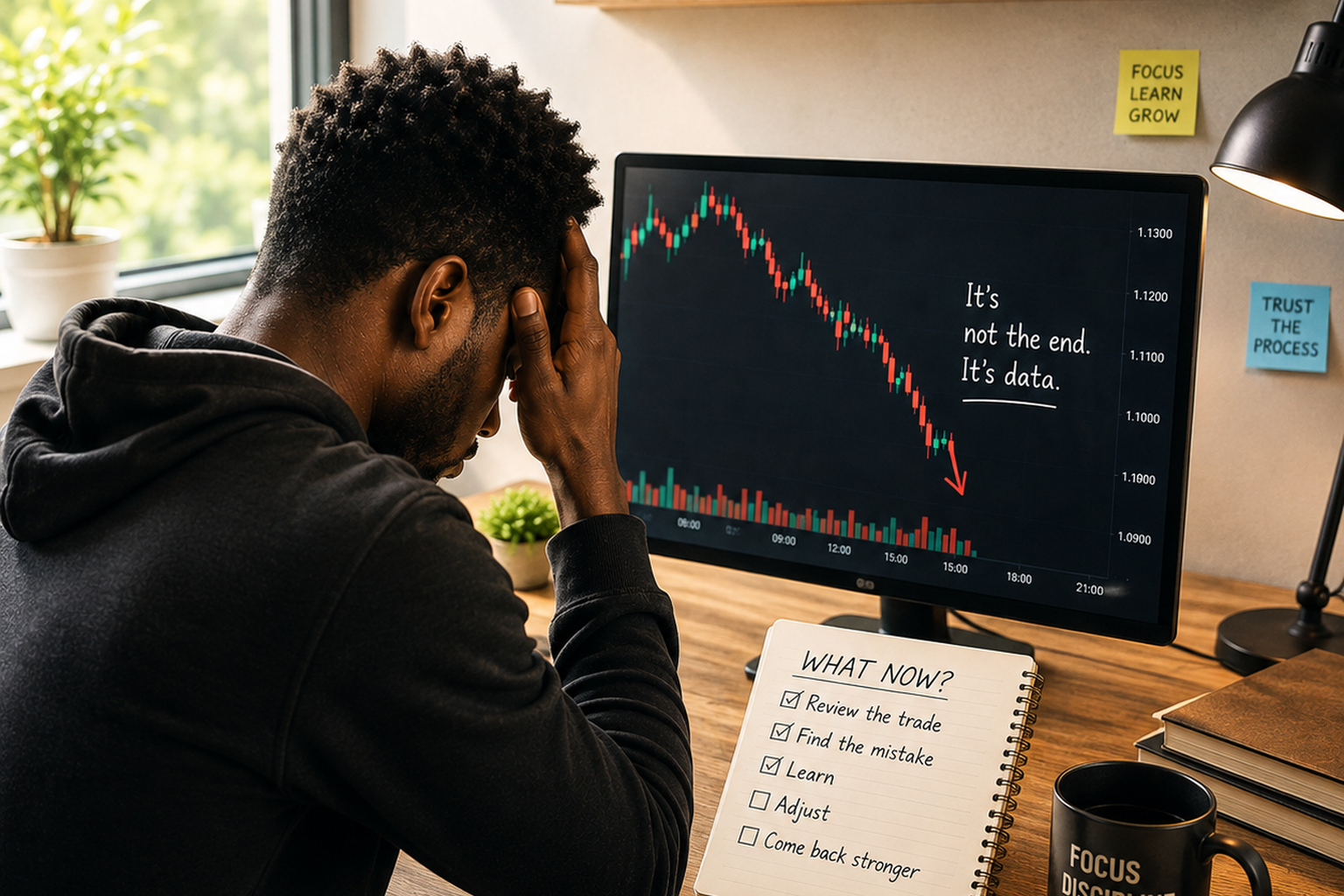
The screen was still open. The chart was still moving. Nothing about the market had changed.
But for the first time, the money on the screen actually meant something.
A few minutes earlier, the trader was excited. He had studied the setup, waited for his entry, and finally took the trade. Then price moved against him. His stop loss was hit. Trade closed.
He stared at the screen for a few seconds.
Then came the question I've heard from so many new traders: "What do I do now?"
It wasn't really the loss that bothered him. It was what the loss made him feel. He started questioning the strategy, then the entry, then the analysis, and eventually, himself.
"Maybe forex isn't for me."
But here's what I told him.
You haven't failed. You just lost a trade.
And those are two very different things.
Your First Loss Feels Bigger Than It Actually Is
When you're starting out, it's easy to imagine that successful traders simply find winning trades. You see the screenshots. You see the profit. You see someone posting that they caught gold perfectly or made $200 from a single setup.
What you don't see are the trades that didn't work. The stop losses, the missed entries, the losing streaks, and the days when the market simply didn't give them anything worth trading.
That's because nobody likes posting their losses.
But losses are part of the game.
You can have an excellent strategy and still lose your next trade. You can analyse the market correctly and still get stopped out. You can do everything according to plan and still watch price move in the opposite direction.
That's forex.
The goal isn't to eliminate losses. The goal is to make sure one loss never has the power to destroy you.
The Most Dangerous Trade Comes After the Losing Trade
This is where things usually go wrong.
You take a loss. You're frustrated. You tell yourself you'll just take one more trade to recover it.
The next setup appears.
You enter.
This time, perhaps you increase your lot size because you don't want to make another small profit. You want to get your money back quickly.
The trade starts moving against you.
Instead of accepting another loss, you move your stop loss.
"It will come back."
It doesn't.
So you take another trade.
And before you realise what's happening, the original losing trade isn't even the problem anymore.
Your reaction to it is.
This is how revenge trading begins. For many beginners, one normal losing trade can turn into a series of emotional decisions that cause far more damage than the original loss ever could.
Stop and Ask Yourself One Question
After a losing trade, don't immediately ask, "How do I make the money back?"
Ask yourself:
"Did I follow my plan?"
That's the question that matters.
If you followed your strategy, used proper risk management, respected your stop loss, and accepted the outcome, then you may not have done anything wrong.
You simply experienced a losing trade.
But if you entered because someone told you to, risked far more than you planned, moved your stop loss because you couldn't accept being wrong, or entered another trade immediately just to recover the loss, then the loss has given you something valuable.
Information.
Now you know what needs to change.
Don't Change Your Strategy Because of One Loss
This is another trap I see beginners fall into.
They lose one trade and immediately decide their strategy doesn't work.
So they switch strategies.
Then they lose another trade.
They switch again.
Support and resistance today. Smart Money Concepts tomorrow. A new indicator next week.
Before long, they have five strategies but no consistency.
The problem wasn't necessarily the strategy. They simply never gave one approach enough time to understand it properly.
One losing trade cannot tell you whether a strategy works. You need a meaningful sample of trades before judging your system.
Think about it. If a striker misses one shot, do you conclude they don't know how to play football?
Of course not.
You look at the whole season.
Trading is no different.
This Is Where Risk Management Changes Everything
Imagine you have a $100 account and decide to risk only 1% on a trade.
You lose.
You're down $1. It doesn't feel good, but you're still in the game. You review the trade and move on.
Now imagine risking 30% because you're "very confident."
The same losing trade suddenly becomes a disaster.
That's why I always tell traders that risk management isn't something you learn after becoming profitable.
It is what allows you to stay around long enough to become profitable.
At KojoForex Academy, this is one of the principles I emphasise from the beginning. Before worrying about how much you can make, you need to understand how much you're willing to lose.
Because if you protect your account, you give yourself something incredibly valuable in trading:
another opportunity.
Your Loss Might Actually Be a Good Thing
I know that sounds strange.
Nobody wants to lose money.
But sometimes a losing trade teaches you more than a winning trade ever could.
A winning trade can make you feel like a genius. A losing trade makes you look in the mirror.
It forces you to ask yourself: Did I enter too early? Did I follow my setup? Was my stop loss in the right place? Did I risk too much? Was I trading because I saw a genuine opportunity, or because I desperately wanted to make money?
Those questions are uncomfortable.
But they're exactly the questions that help you grow.
The trader who learns from a loss becomes better. The trader who hides from a loss repeats it.
What I Want You to Do After Your Next Loss
Don't immediately open another trade.
Step away from the chart for a moment. Take a breath. Then come back and review what happened.
Look at the setup you entered. Look at where you placed your stop loss. Look at your reason for entering. Then ask yourself whether you followed your rules.
If you did, accept the loss.
If you didn't, identify the mistake.
Write it down.
Don't just say, "I'll remember next time." You probably won't.
Keep a trading journal and document your mistakes. After twenty, thirty, or fifty trades, you'll start seeing patterns in your behaviour that you couldn't see from one trade alone.
Maybe you keep entering too early. Maybe you close winners too quickly. Maybe you trade more aggressively after losing. Maybe you only make mistakes when you're tired or frustrated.
Your journal can reveal those patterns.
And once you can see the problem, you can start fixing it.
This Is Why Learning With the Right People Matters
You can learn a lot by yourself. But sometimes you need someone who can look at your trade and say, "Your analysis wasn't bad. Your risk was the problem."
Or, "You entered correctly, but you broke your own rules when the trade started moving against you."
That's one of the biggest benefits of learning at KojoForex Academy.
You're not just being shown charts and told where to enter. You're learning how to think through the trade, how to manage risk, how to stay disciplined, and how to review losses objectively instead of emotionally.
From the Complete Beginner Course to the Beginner Session, Advanced Session, and One on-One Mentorship, the focus is on developing traders who understand the market and, just as importantly, understand themselves.
Because knowing how to find a setup is only one part of trading.
Knowing how to behave when that setup loses is another.
Don't Rush to Recover Your Money
This might be the hardest lesson to accept.
You don't have to recover today's loss today.
If you lose $10 on Monday, the market doesn't owe you that $10 back on Tuesday.
And trying to force it back is exactly how a small loss becomes a large one.
There will always be another setup. Another session. Another trading day. Another opportunity.
The market isn't going anywhere.
Your job is to make sure your account doesn't either.
When You're Ready to Trade Live
If you're still learning, there's no shame in staying on demo while you build your skills.
And when you're ready to open a live account, start small enough that your emotions don't take control of your decisions.
I recommend Exness for traders who are ready to make that step, particularly because of its instant deposits and withdrawals and the trading conditions available to its users.
More importantly, if you register through my recommended Exness link, you'll receive FREE access to the KojoForex Complete Beginner Course.
That means you can build your foundation before putting serious money at risk.
Learn.
Practise.
Make mistakes where they cost you nothing.
Then gradually increase your exposure as your discipline and consistency improve.
There's no prize for rushing.
Your First Loss Doesn't Define You
Years from now, you probably won't remember the exact amount you lost on your first trade.
But you might remember how you felt.
You might remember staring at the screen and wondering whether you were good enough. You might remember the temptation to immediately win it back. And hopefully, you'll remember the lesson you learned from it.
Because your first losing trade isn't proof that you can't trade.
It's your first opportunity to learn how you respond when things don't go your way.
That is a much more important lesson than knowing how to find another entry.
So if you just lost your first trade, don't panic.
Don't revenge trade.
Don't double your lot size.
Don't throw away your strategy after one loss.
Take a step back.
Review what happened.
Learn from it.
And come back tomorrow with the same discipline you had before the trade.
Because the traders who eventually become consistent aren't the ones who never lose.
They're the ones who learn how to lose without losing control.